
Meet the Members of the Public Choice Society
Get to know the scholars behind the Public Choice Society. Our Member Profiles series explores the ideas, experiences, and influences that shape the work of PCS members—from the questions that first drew them to political economy and public choice to the research they are pursuing today.
Through candid conversations, members share their academic journeys, perspectives on institutions and political economy, experiences with the Public Choice Society, and the books and scholarship that have influenced their thinking.
Whether you are a longtime member, an early-career scholar, or new to the field, these profiles offer a closer look at the people and ideas that make the Public Choice Society community distinctive.
- From Engineering to Public Choice: Jamie Bologna Pavlik on Institutions, Corruption, and Academic Community
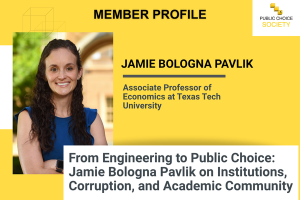 Jamie Bologna Pavlik, now an Associate Professor of Economics at Texas Tech University, did not begin her academic journey expecting to study political economy. She entered college planning to major in mechanical engineering, but in this Member Profile, she shares what changed her direction. Today, Pavlik’s research focuses on corruption and political institutions in Latin America, particularly Brazil. A longtime participant in Public Choice Society meetings, she discusses why she became interested in this topic, and how the Society has helped shape her career.
 - From Political Economy to AI Governance: Niclas Berggren on a Career in Public Choice
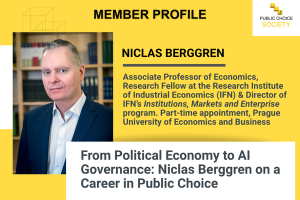 For nearly three decades, Niclas Berggren has been a familiar presence at Public Choice Society meetings. His journey into public choice began at the Stockholm School of Economics, where courses in political economy and other topics changed the direction of his career. Today, Berggren’s research explores the intersection of institutions, culture, freedom, and political behavior, with recent work examining how public choice theory can illuminate debates over AI governance in academia. In this member profile, Berggren reflects on the scholars who shaped his thinking, his research, and why PCS’s supportive community makes it an especially valuable conference for young researchers.
 - From a Coup in Honduras to the Political Economy of Property Rights: Meet Ricardo Noé
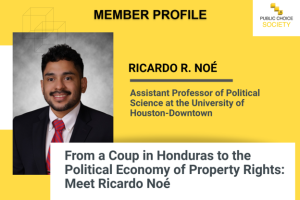 Ricardo R. Noé’s journey into political economy began at age 14, when he witnessed the 2009 coup d’état in Honduras and began questioning the relationship between political and economic forces. Today, his research examines the political economy of property rights in Latin America, with a focus on how property rights shape political power and institutional development. In this conversation, Noé discusses the scholars who influenced his work, the lessons his research has taught him about institutions and intellectual humility, and his experience as an early-career scholar in the Public Choice Society. He also shares recommendations for books exploring property rights, political institutions, and economic development.