
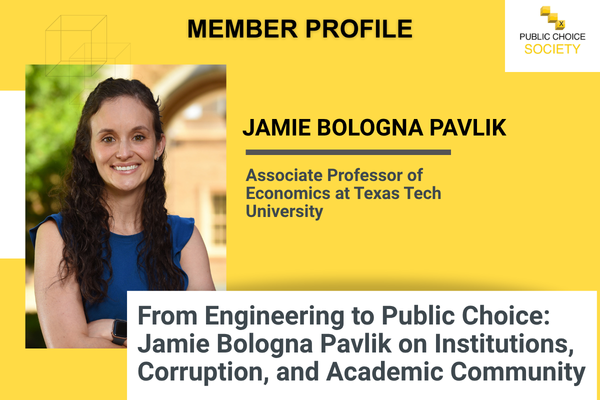
From Engineering to Public Choice: Jamie Bologna Pavlik on Institutions, Corruption, and Academic Community
Jamie Bologna Pavlik, now an Associate Professor of Economics at Texas Tech University, did not begin her academic journey expecting to study political economy. She entered college planning to major in mechanical engineering, but in this Member Profile, she shares what changed her direction.
Today, Pavlik’s research focuses on corruption and political institutions in Latin America, particularly Brazil. A longtime participant in Public Choice Society meetings, she discusses why she became interested in this topic, and how the Society has helped shape her career.
Meet Jamie Bologna Pavlik.
Question: How did you first become interested in political economy and public choice?
I started college as a mechanical engineer, but an introductory economics class in my first semester made me switch majors immediately. I was fortunate that my university had an economics reading group led by Todd Nesbit, a regular at Public Choice Society meetings. Early on, he had us read Making Poor Nations Rich, edited by my now‑colleague Ben Powell.
That book included William Baumol’s work on productive, unproductive, and destructive entrepreneurship—an ideal introduction for someone new to economics. Baumol’s framework showed me how institutions shape incentives and determine the kinds of entrepreneurship societies get. Every society has entrepreneurs; what differs is whether institutions encourage productive or unproductive activity. That idea fascinated me.
Initially, I was more drawn to development economics. I wanted to understand why some nations are rich and others poor. I applied to programs with strong development fields and chose West Virginia University, which offered both development and public choice.
What ultimately pulled me toward public choice was encountering research on corruption in a development course. One paper examined anti‑corruption strategies in Indonesia and found that top‑down monitoring was more effective than empowering citizens. I found that counterintuitive and wanted to understand why. That curiosity led me deeper into studying corruption and political institutions, and that’s where much of my research has focused ever since.
Question: What is one takeaway from your research that you wish policymakers better understood?
The biggest takeaway is that some things that look bad from the outside exist for a reason. Corruption is a perfect example. International organizations often identify corruption as a major problem and design programs to reduce it. They’re sometimes surprised when those programs don’t work.
I want policymakers to ask why corruption exists. Understanding its origins tells you more about its nature and what reducing it would actually do to an economy. Much of my research is in Brazil, which has significant corruption but also significant bureaucracy and red tape. Some corruption is not simply malfeasance by politicians; it’s a response to excessive regulation.
If you don’t understand the informal markets and institutional constraints that give rise to corruption, it’s very hard to fight it effectively. And some reforms can make things worse.
Question: Is transparency always an effective way to fight corruption?
Transparency can be valuable, but we need to be careful. Freedom‑of‑information laws, exposing scandals, and allowing voters to remove corrupt officials are often cited as solutions. But research in economics and political science shows that exposing corruption can have unintended consequences.
For example, when a corruption scandal was exposed in Italy, supermarket theft increased (Gulino and Masera 2023). In Mexico, corruption exposure was associated with higher rates of cheating among students (Ajzenman 2021). Other research shows that when political leaders are identified as corrupt, voters may withdraw from the political system (Chong et al. 2015).
That’s obviously not the goal of transparency. The larger point is that we need to understand the context in which corruption occurs. We shouldn’t treat all corruption the same. Sometimes the underlying institutional problems are bigger than the problem of corruption itself.
Question: You primarily study corruption in Latin America. Why focus your research there?
Most of my work is empirical, and the measures of corruption used in the United States aren’t particularly strong. One common measure uses state‑level corruption convictions scaled by population, but that can be misleading. A small state with one conviction can look highly corrupt in per capita terms, while a large state with many convictions may appear less corrupt.
More importantly, Jeff Milyo, a Director of the Public Choice Society, has done important work on biases in these measures. Some data come from surveys of prosecutors, which raises reliability concerns. And some behaviors classified as corruption—like post office theft—aren’t what we typically think of as political corruption.
The United States also has a relatively strong rule‑of‑law system. If someone tried to bribe me here, I’d have options, including legal recourse. In countries with a weaker rule of law, people may be more easily coerced. Those institutional differences matter, and much of my research is about understanding why corruption varies across countries.
Latin America offers richer data and more institutional variation. Brazil, in particular, has been a great place to test public choice ideas. Random audits exposed corrupt mayors, and voters responded by voting them out (Ferraz and Finan 2008). Researchers also found that second‑term mayors who couldn’t run again were more corrupt than first‑term mayors who could (Ferraz and Finan 2011). Those are classic public choice dynamics.
Question: How did you first become involved with the Public Choice Society?
I started graduate school at West Virginia University in 2011. At the time, most graduate students and faculty attended three conferences a year: the Southern Economic Association meetings, the AEA meetings, and Public Choice. Beginning in my second or third year, I started attending all three.
All were valuable, but the Public Choice Society meetings were especially important for me. I met one of my external dissertation committee members, Jac Heckelman, at a PCS meeting. He came to my presentation, gave me substantial feedback, and stayed in contact. Jeff Milyo is another scholar I met through PCS. Senior scholars were very open to working with graduate students in ways that didn’t always happen at other conferences. Those relationships were incredibly meaningful.
Question: What is the best reason for a young scholar or graduate student to attend PCS conferences?
The network is the best reason. The conference is large enough to have many participants but small enough that everyone is approachable. You can meet people you might never meet at a larger conference.
It’s not just networking, though. Sessions are focused, and presenters often work on similar topics. You get new research ideas and meet people who can become collaborators. Many graduate students attend, and meeting peers from other programs is extremely helpful.
PCS is a welcoming and productive environment. The Ostrom Prize is fantastic, and the feedback on papers is strong. I’ve never been to a bad session at Public Choice.
Question: You’ve developed a reputation for working closely with graduate students. What matters to you about mentoring?
The Free Market Institute at Texas Tech University is a great place for graduate students. It creates a really active intellectual community where faculty and students interact constantly, which isn’t true everywhere. From their first year, graduate students participate in weekly brown bags where they share ideas, get feedback, and engage with faculty and other students.
I usually start working with students after they take my development course. I try to show them how interesting research can be and encourage creativity. I give detailed, constructive feedback. Many students are afraid to share ideas or don’t know how to even start developing them. I share examples from my own research, explain how I develop ideas, and introduce them to a variety of methods.
Overall, our student success is really about departmental culture. We treat graduate students as future colleagues. That changes the dynamic and makes everyone more productive. Students participate in seminars and ask questions of visiting scholars. We work on research ideas with them early on. One of my former students, JP Bastos, won the Ostrom Prize this year, and we often spent hours discussing research and ideas..
Question: Is there recent work you think PCS members should know about?
I want to highlight the Public Choice in Latin America project, run by my former student JP Bastos and Nicholas Cachanosky. It showcases research on populism, corruption, and political incentives across the region. There’s a lot of interesting work coming out of Latin America.
Researchers are also testing public choice ideas in mainstream economics journals. For example, studies examine whether electoral incentives limit corruption and how corruption exposure affects voting. In Brazil, random audits exposed corrupt mayors, and voters responded. Term‑limited mayors were more corrupt than those who could run again—classic public choice results.
Question: Is there a particular paper you’re following now?
A recent working paper by Claudio Ferraz and coauthors, The Real Costs of Washing Away Corruption, examines Brazil’s Lava Jato anti‑corruption crackdown. The effort reduced corruption but also caused economic harm—firms cut employment, investment declined, and growth slowed.
The broader lesson is that you can’t simply eliminate corruption because it seems bad. You need to understand its institutional causes first. That’s what makes the research so compelling.
Question: What would you like to leave PCS members with?
The Public Choice Society is a welcoming community, and I hope it stays that way. It has had a profoundly positive impact on my career. The relationships I formed—from mentors who offered guidance to graduate students who became colleagues—shaped my professional life.
My own mentoring reflects that experience: creating a culture where students share ideas, receive substantive feedback, and begin seeing themselves not just as students, but as future colleagues.
Interested in learning more about the Public Choice Society’s annual meeting in New Orleans? Visit our information page.