
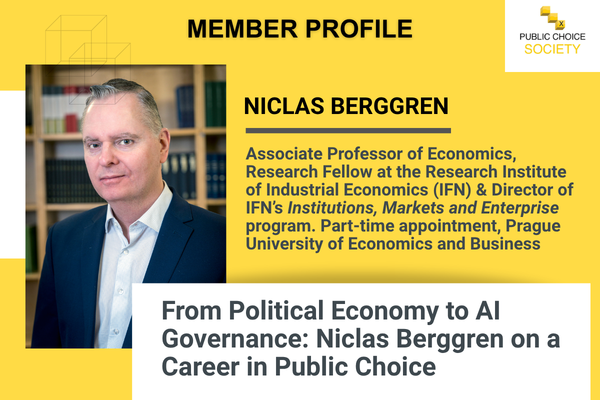
From Political Economy to AI Governance: Niclas Berggren on a Career in Public Choice
For nearly three decades, Niclas Berggren has been a familiar presence at Public Choice Society meetings. A member of the PCS Board of Directors, he is a researcher at the Research Institute of Industrial Economics (IFN) in Stockholm and program director for Institutions, Markets and Enterprise. He earned his PhD and the title of docent (Associate Professor) from the Stockholm School of Economics and also works part-time at the Prague University of Economics and Business.
Berggren works at the intersection of public choice, constitutional economics, economic freedom, and the economics of culture. In a recent conversation with PCS, he reflected on the ideas that drew him to political economy, the scholars who shaped his career, his research on AI governance in science, and why PCS remains an excellent conference for young researchers.
Question: How did you first became interested in political economy and public choice?
Niclas Berggren: My interest in public choice goes back quite far. As a teenager, I was active in the youth organization of Sweden’s main center-right political party, the Moderate Party. I was interested in both politics and economics, and those interests came together when I enrolled at the Stockholm School of Economics (SSE) in 1988.
Initially, I planned to become a financial trader, drawn to newly deregulated financial markets and emerging instruments like options and futures. But my first economics course, which used Edmund Phelps’s Political Economy: An Introductory Text, sparked a deeper interest by connecting politics and economics.
A year later, an institutional economics course taught by Johan Myhrman introduced me to Geoffrey Brennan and James Buchanan’s The Reason of Rules: Constitutional Political Economy. The book was transformative. It challenged the assumption that governments simply pursue the public good and introduced the idea of government failure alongside market failure.
Those ideas shaped my undergraduate thesis on VAT reductions for food, which analyzed the policy as an example of interest-group activity. In 1991, I began doctoral studies at SSE and later changed advisors to Karl Wärneryd, who introduced me to George Mason University’s Center for the Study of Public Choice and the Public Choice Society.
With Karl’s encouragement, I received a Fulbright scholarship to spend the 1993–1994 academic year at George Mason. There I studied with Robert Tollison, Kevin Grier, David Levy, James Buchanan, and Viktor Vanberg. The experience solidified my commitment to public choice.
After returning to Stockholm, I completed my PhD and expanded my research into areas including economic freedom, culture, trust, tolerance, and religion. The scholar who has influenced me most is James Buchanan. His ideas first inspired me through The Reason of Rules, and studying with him at George Mason deepened that influence.
Question: What is one takeaway from your research that you wish policymakers, students, or the broader public better understood about institutions and political development?
Niclas Berggren: I’ve done a lot of work on economic freedom and how markets can generate not only economic growth but also trust and tolerance. I’ve also studied the role of beauty in politics and how politicians’ appearances can influence electoral success.
For this interview, though, I’d like to highlight my recent article, accepted by Public Choice, titled “An Interest-Group Theory of AI-Tool Governance in Science.” It demonstrates how public choice theory can explain reactions to technologies that create uncertainty or threaten established positions.
We should be cautious about assuming institutions and rules are simply designed to promote the public good. Regulations are often shaped by groups with particular interests. In my paper, I argue this applies not only to governments but also to academia—universities, journals, funding agencies, and professional associations.
AI tools have the potential to improve scientific productivity and quality, but they don’t benefit all researchers equally. Some can use AI effectively for coding, data analysis, literature reviews, drafting, and idea generation, while others benefit less. Because academic careers depend heavily on relative performance, those who benefit less may have incentives to support restrictions on AI use to preserve their competitive position.
I particularly enjoyed modeling this conflict using the Tullock contest, developed by Gordon Tullock, founding editor of Public Choice and co-founder of the Public Choice Society. The model explains how competing groups invest time, influence, and organizational effort to shape institutional rules.
The analysis shows that restrictions on AI can emerge even when the technology produces overall social benefits. Greater competition within academia increases incentives to regulate AI, while concerns about reputation or compliance may strengthen support for restrictions even when evidence of harm is limited.
The broader takeaway is that we shouldn’t accept stated justifications for regulations at face value. Some people support AI restrictions because they believe the technology poses genuine risks; others may be motivated by self-interest if they feel disadvantaged by AI. That’s a classic public choice insight applied to one of today’s most important technological developments.
Question: How did you first become involved with the Public Choice Society?
Niclas Berggren: My second PhD advisor at the Stockholm School of Economics, Karl Wärneryd, had connections to the society and public choice community and recommended that I attend.
My first meeting with PCS was in New Orleans at the Hotel Monteleone in 1999. I have attended most years since then, and it is a recurring highlight of my academic year. I’ve been on the Board of Directors since last year, which is a great honor. I cherish the PCS and want to see it continue flourishing for many years to come.
Question: What is the best reason you would give someone—especially a young scholar or graduate student—for attending a PCS conference?
Niclas Berggren: My general advice to young colleagues is to start going to conferences, both for scientific and social reasons. You get feedback on your work, practice presenting, form networks, find co-authors, and make friends who will support you throughout your career. Many journal editors and referees also attend, so getting to know scholars in your field can be an advantage.
In economics and the social sciences, there are large general-interest conferences like the American Economic Association (AEA/ASSA), European Economic Association (EEA), and Southern Economic Association (SEA), as well as smaller, specialized meetings like PCS. If forced to choose, I recommend the smaller, specialized ones.
When it comes to PCS, there are several strong reasons:
- The Size is Just Right: There are about 300 scholars, making it easy to get an overview of the program and get to know people.
- The Atmosphere: Unlike some larger conferences, PCS has a warm, supportive environment where people genuinely try to help you become a better scholar.
- The Content: It’s a great match for those interested in public choice, political economy, institutional economics, or constitutional economics.
- Methodological Diversity: Both theoretical and empirical work are well represented, including formal models, analytic narratives, and economic philosophy.
- The Ostrom Prize: PhD students can compete for the Elinor & Vincent Ostrom Prize—a $2,000 award for the best graduate student paper and presentation.
- Reasonable Pricing: Registration is $290 for graduate students and $395 for others, lower than most conferences.
- Exotic Locations (for Europeans!): The conference is often held in culturally interesting U.S. cities such as Dallas, New Orleans, San Antonio, Nashville, Charleston, and Savannah. March weather is also usually much warmer than in Northern Europe!
Question: Is there a recent book, paper, or article that you’ve read that you think other members of PCS should know about?
Niclas Berggren: One of the most impressive books I’ve read in the past couple of years is Mark Pennington’s Foucault and Liberal Political Economy: Power, Knowledge, and Freedom, published by Oxford University Press in 2025. I reviewed it for Public Choice earlier this year and take every opportunity to recommend it. Although it’s not a public choice book in the traditional sense, I think it’s an excellent companion to the field.
Pennington combines Foucauldian ideas about power with liberal political economy, arguing that freedom is an ongoing process of individual self-creation shaped by multiple power relationships. He is skeptical of the idea that social science can objectively engineer better societies and emphasizes the limits of centralized knowledge and social control. He applies this framework to issues such as social justice, public health, sustainability, and law and order, showing how well-intentioned policies can unintentionally restrict individual freedom.
Public choice scholars, in particular, would benefit from reading it. Traditional public choice generally treats individual preferences as fixed, whereas Pennington explores how preferences and identities are shaped by cultural and institutional forces. He also broadens our understanding of power, showing that it operates through governments, markets, civil society, and other social institutions.
I don’t agree with everything in the book. Pennington is much more critical than I am of positivist social science and econometric methods. Even so, it’s a thoughtful, philosophically rich work that challenges readers to think differently about power, freedom, and institutions.
Interested in learning more about the Public Choice Society’s annual meeting in New Orleans? Visit our information page.