
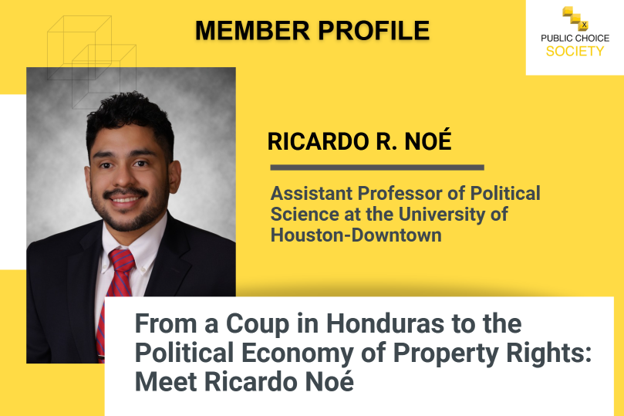
From a Coup in Honduras to the Political Economy of Property Rights: Meet Ricardo Noé
For Ricardo R. Noé, an interest in political economy began not in a classroom, but during a moment of profound political upheaval. At age 14, Noé lived through the 2009 coup d’état in Honduras. Watching political disruption unfold—and seeing how political forces shaped economic interests, while economic interests in turn influenced politics—prompted him to begin asking the questions that would eventually define his scholarly career. Today, Noé is an Assistant Professor of Political Science at the University of Houston-Downtown whose research focuses on the political economy of property rights in Latin America.
His work integrates formal theory and mixed methods to examine how property rights shape political development. A central theme of his research is that property rights are not simply economic institutions: They are political institutions as well.
Meet Ricardo Noe.
Question: How did you first become interested in political economy and public choice? Was there a particular question, class or scholar that sparked your interest in studying how political institutions shape economic outcomes?
Ricardo Noé: It was a combination of intellectual influences and a life event. When I was 14, I lived through the 2009 coup d’état in Honduras. It was a major moment of political disruption, and I saw how different factors influenced politics and economics—how politics influenced economic interests and how economic interests, in turn, influenced the politics of the country. That was the first major moment when I began asking those questions.
What pushed me in the direction of public choice was the scholar Peter Boettke. He has worked on so many different topics of personal interest, and he is also a past Buchanan Fellow of the Public Choice Society. His scholarship has influenced my research program and the type of research I do. The references in his papers are what led me to public choice and new institutional economics.
Question: What is one takeaway from your research that you wish policymakers, students or the broader public better understood about institutions and political development?
Noé: When we talk about property rights, we usually discuss them as economic institutions, and I think we often ignore their political dimension.
One thing my research has taught me is that property rights not only influence the flow of goods, services and entrepreneurship—which can help explain processes of economic development—but they also influence power. And power influences the development of political institutions.
One of the things I have learned from public choice is the importance of intellectual humility. Political economy encourages this. As a framework, it allows us to understand that the world is complex and that we should approach policy issues and their solutions with a sense of humility.
Those are two of the major takeaways I have learned from my research and, more importantly, from the scholarship I have engaged with through public choice.
Question: Do you have an example from Honduras or another political situation that illustrates this lesson?
Noé: Returning to the question of how property rights influence politics, I am currently working on a project that studies coups d’état in Latin America.
What I have noticed is that the type of property rights regime—whose rights are protected—can affect whether there is an incentive to disrupt a political system.
In this project, I examine how banana companies competed over property rights during the Banana Wars period in Honduras. When companies failed to secure the property rights they wanted, that had negative political consequences. They created incentives for political disruption, including coups d’état.
That is something I have learned through my recent scholarship and research.
Question: How did you first become involved with the Public Choice Society?
Noé: I attended my first Public Choice Society annual meeting in 2021 as a first-year PhD student, and I have not missed a meeting since. I have attended every year.
Before 2021, I had spent a lot of time studying independently. I had an area studies master’s degree, and we were encouraged to pursue independent study projects. I decided that I wanted to read the public choice and new institutional economics literature, starting with James Buchanan’s Limits of Liberty, Svetozar Pejovich’s The Economics of Property Rights,and Eirik Furubotn’s and Rudolf Richter’s Institutions and Economic Theory.
As I learned more about the field, I discovered the Public Choice Society. It became a dream of mine to present at the annual conference.
My first meeting in 2021 was especially meaningful because it took place during COVID. My first year of doctoral studies consisted largely of online classes and very little on-campus interaction. The 2021 meeting changed that, and I finally felt like a PhD student and a scholar.
I was surrounded by scholars whose work I admired and regularly cited, but they also actively welcomed me and asked me questions about my work.
I have to point out that Edward Lopez was the first person I talked to at a Public Choice Society annual meeting. He introduced himself early on, sat through my first presentation and provided comments afterward—comments that I still appreciate today.
You regularly see that kind of interaction at the Public Choice Society. You attend the conference, talk with scholars, and experience a culture that makes you want to continue being involved.
Question: What is the best reason you would give someone—especially a young scholar or graduate student—for attending a Public Choice Society conference?
Noé: The Public Choice Society has given me so much as an early-career scholar. I graduated a year ago and am now a faculty member, and I feel that much of my professional development came from being involved with the Society.
It provides early-career scholars with opportunities that I do not think many other conferences can offer. It is easy to lose yourself at extremely large conferences, and meeting new people in those environments can be overwhelming. As an introvert, I find those environments particularly challenging.
But if your field is political economy, many of the same people you would encounter at these large conferences also attend the Public Choice Society meeting—and at PCS, you can actually talk to them.
They may serve as a discussant for your paper, provide comments on your work, offer mentorship and much more. The Society and the scholars involved are genuinely invested in your academic success.
I remember scholars learning about my new position after graduate school and congratulating me immediately. They are happy when you publish something new. They provide comments that help you get your work to the point where it is ready to publish. They are invested in where you end up after you graduate.
The kindness I have received from scholars in the Public Choice Society is not easily replicated elsewhere. My experience with PCS has been very unique.
Edward Lopez has served as an important mentor throughout my career. Former PCS President David Skarbek served on my dissertation committee and provided a great deal of guidance. To this day, he continues to be very helpful.
Finally, the Society’s past presidents are evidence of its robust and rich intellectual tradition. Being part of that tradition is something special. The participants in the Public Choice Society and its annual conference make you feel like you are part of that long and rich intellectual history.
I am genuinely very proud to be a part of it, and I think it is a resource that many young scholars can benefit from.
Question: Is there a recent book, paper or article that you have read that you think other PCS members should know about? Why did it stand out to you?
Noé: I would recommend two books. Both were published recently.
The first is Michael Albertus’s Land Power. In addition to the work of Public Choice Society President-Elect Jennifer Brick Murtazashvili and her co-author Ilia Murtazashvili, Michael Albertus is at the forefront of research on the political economy of property rights.
One of the things his book emphasizes is that property rights are not only economic institutions; they are also political institutions. The book is extremely insightful on the relationship between property rights, land rights and the evolution of political institutions, as well as how individuals hold power. I think more public choice scholars should engage with this work.
The second book is William Easterly’s The Tyranny of Experts, which focuses on economic development and development policy.
One of the book’s major themes is the importance of intellectual humility in problem-solving. For public choice and political economy scholars interested in policy, I believe Easterly’s argument is highly consistent with the James Buchanan tradition of social science research, particularly when considered alongside the themes of Buchanan’s Nobel Prize lecture.
Those are the two texts I would recommend. More broadly, I think more people should be working on the political economy of property rights, and these books can be extremely helpful for anyone interested in that area.
Interested in learning more about the Public Choice Society’s annual meeting in New Orleans? Visit our information page.